

Aligners for Adults: 7 Things Almost No One Knows Going In
An aligner for adults—it sounds easier than it sometimes is. Anyone looking into this has usually already read quite a bit: testimonials, price comparisons, before-and-after photos. And yet, most questions don’t come up until the treatment becomes a concrete reality. I, Dr. Alessja Indin, work every day at my practice on Ludwigstraße in Offenbach with people who want to undergo orthodontic treatment—and who want to know what to really expect.
What I find time and again is that a well-prepared decision makes the treatment easier—for both sides. These seven points can help.
Table of Contents
1. An aligner only works if you follow through consistently
That's the point I bring up most often—and the one that's most often underestimated.
A clear aligner only moves teeth if it is worn long enough. The recommended wear time is 20 to 22 hours a day. It should be removed for eating, drinking hot or strongly colored beverages, and for oral hygiene. That sounds doable—and it is, if you take it seriously from the start.
What many people don't realize: Wearing the dental splint at night isn't just a recommendation—it's a requirement. During the day, the chewing muscles, tongue pressure, and lip pressure exert constant force on the teeth. If you don’t wear the aligner at night, you give these forces free rein—and lose a significant portion of the planned wear time. Some patients read that 16 hours a day is sufficient. This applies in certain cases involving very minor corrections—and is not a universal rule.
Aligner therapy is not a passive process. It is a decision that is renewed every day. Those who understand this and commit to it will reach their goal on time.
2. Not every type of misalignment is suitable for aligners
Aligners are a precise, elegant tool—but not a one-size-fits-all solution. There are cases where they work very well, and cases where another method is the more honest recommendation.
Aligners are well-suited for mild to moderate crowding, individual tilted teeth, small gaps, and aesthetically problematic alignments in the front teeth. However, they reach their limits in cases of pronounced rotations, severe malocclusions, or skeletal abnormalities. In these cases, fixed braces—or a combination of orthodontic and surgical treatment—are the medically sounder choice.
If you come to our office with a diagnosis for which aligners are not the right solution, you’ll receive exactly that assessment—not a treatment that only partially addresses the problem. As your dentist in Offenbach-Westend, we’ll determine whether aligners are right for you during a thorough initial examination.
— Dr. med. dent. Alessja Indin, owner of the Dr. Indin & Team dental practice in Offenbach am Main"I only recommend aligner treatment if the indication is truly appropriate. Anything else would be neither honest nor sustainable."
3. Digital scanning is changing the way aligners are made
Anyone who is familiar with or has heard of aligner treatment from years past may remember impression trays and impression material. Things are different today.
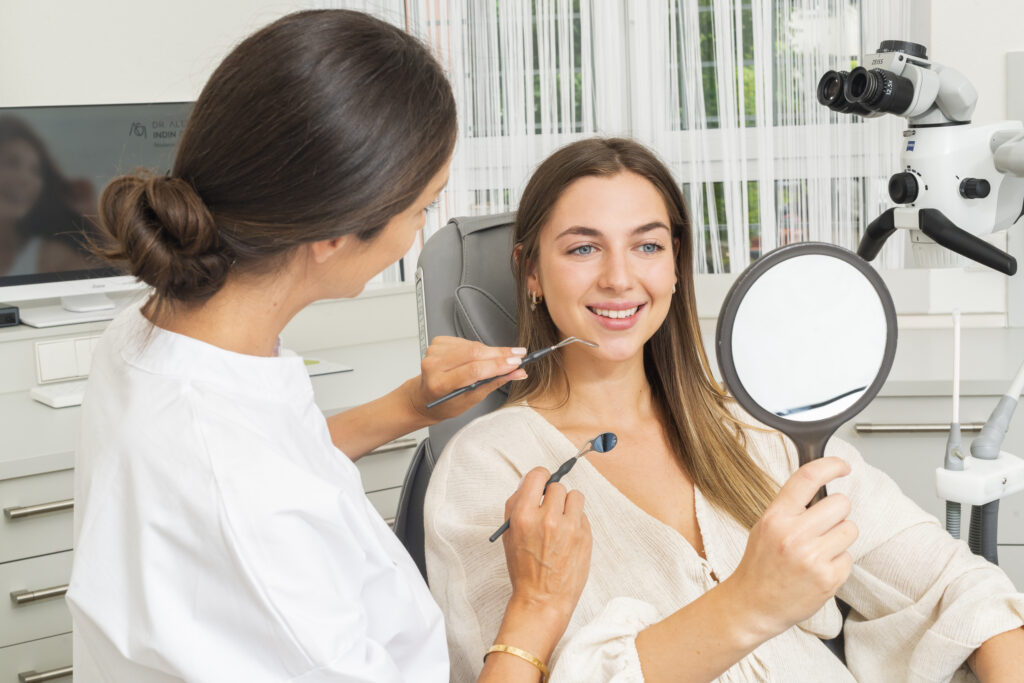
At Dr. Indin’s practice, your dentist in Offenbach-Westend, we use the Medit i900 intraoral scanner—a device that digitally captures images of your teeth in just a few minutes, with precision and complete comfort. No material in your mouth, no unpleasant gag reflex, and no waiting for the impression to set. The digital scan provides an exact three-dimensional foundation for the treatment plan—and thus also ensures a perfect fit.
What this means for you: Starting aligner treatment has become much more comfortable. And more precise.
4. You'll see the results of your aligner before treatment begins
That's one of the things that most often surprises patients—in a good way.
Before even a single aligner tray is manufactured, a simulation of the planned tooth movements is created based on the digital scan. You’ll see, step by step, how your teeth will shift over the course of treatment—and what the final result is expected to look like. Only once you approve this plan will production begin.
This has two advantages. First, you know exactly what to expect—not just a general description, but a concrete explanation. Second, your expectations and the treatment goal are aligned from the very beginning. This prevents disappointment and establishes a common foundation for the entire course of therapy.
You can find a detailed overview of all the steps—from the initial scan to the retainer—on our page about aligner treatment in Offenbach.
5. Invisalign® is a brand—there are various systems on the market
Many patients come to the consultation mentioning the term “Invisalign®”—but what they actually mean is clear aligners in general. This is understandable: Invisalign® has had a major impact on the market for clear aligners and is the best-known brand in this field. When people read reviews, they often come across Invisalign® reviews—even though the method behind it is the same as that of other systems.
"Clear aligner" is the umbrella term for all transparent, removable dental aligners used for orthodontic treatment—regardless of the manufacturer. Invisalign® is one brand in this category, Spark™ is another, and 3M Clarity is yet another. The systems differ in terms of material, manufacturing precision, and digital workflow.
Dr. Indin’s practice uses Ormco’s Spark™ Aligners—because of the highly transparent, low-staining material and because the system integrates seamlessly into the practice’s digital workflow. Invisalign® is a good system. It’s just not the one this practice uses.
6. The retainer is the final and most important step in any aligner treatment
This point is most often seen as a surprise—even though it actually makes sense.
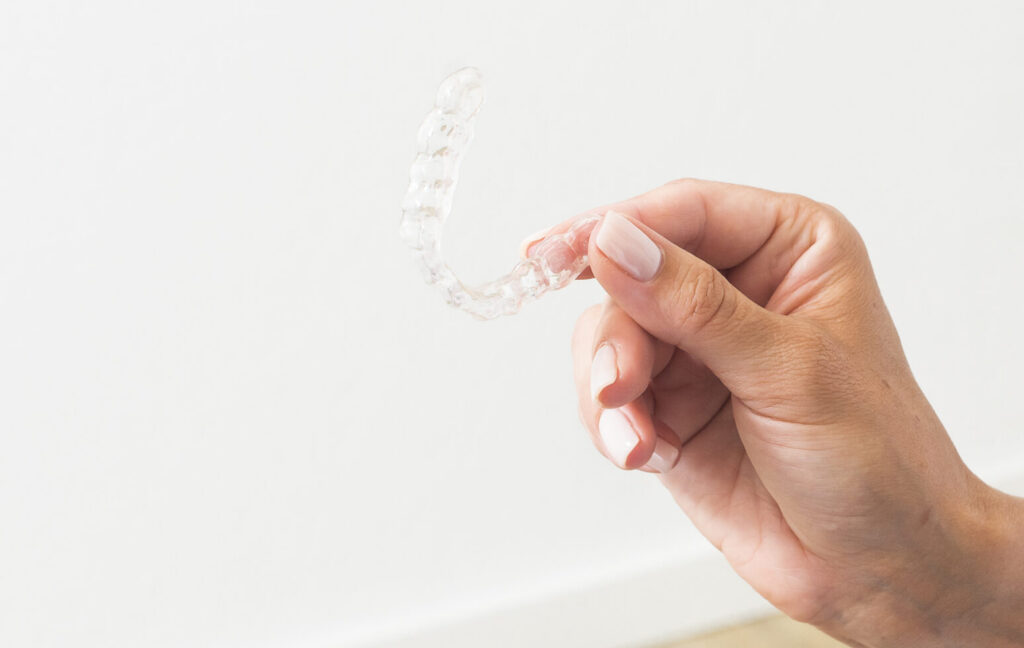
Teeth have what is known as “memory.” After orthodontic treatment, they tend to slowly shift back to their original position—regardless of how long the treatment lasted or how carefully it was performed. This applies to fixed braces as well as aligners.
A retainer—a thin wire attached to the inside of the front teeth—or a removable retainer prevents exactly that. It is not an optional final step, but an integral part of every completed aligner treatment at the practice. Anyone who skips this step risks the results of the entire treatment gradually shifting.
— Dr. med. dent. Alessja Indin, owner of the Dr. Indin & Team dental practice in Offenbach am Main“For me, the retainer is the final and most important step. Without it, all the work done before would not be sustainable—I tell every patient this before starting treatment.”
7. Sometimes there is a functional cause behind the misalignment
This point doesn't apply to everyone—but it affects more people than you might think.
Misaligned teeth aren't always just a mechanical problem. Incorrect swallowing patterns, mouth breathing, and an unfavorable resting position of the tongue—all of these can affect tooth alignment. If these underlying causes are left untreated, there is a risk that the teeth will drift back to their original positions after aligner treatment because the underlying functional pattern has not changed.
In addition to aligner therapy, Dr. Indin’s practice also offers Dentosophy—a functional approach that addresses swallowing patterns, respiratory function, and jaw development. The treatment device is the Equilibrator, which is worn over an extended period of time to gently realign functional patterns.
Aligners and dentosophy are not mutually exclusive. In certain cases, they complement each other very well: The aligner corrects the visible alignment of the teeth, while dentosophy addresses the underlying causes. An initial examination will determine whether this is relevant—with no obligation to proceed beyond what is necessary.
Your Aligner at the Dentist in Offenbach – Be Well-Informed for Your Consultation
If you're familiar with these seven points, you'll come to the consultation well-prepared. This makes the discussion more focused—and the decision easier.
If you’re looking for a dentist in Offenbach for an aligner consultation, you’ll find us at Ludwigstraße 34 in Offenbach-Westend. Here, we take the time to address your specific situation. No waiting in line, no time pressure. If you’d like, we can take a digital scan during your first appointment—so you can get a clear idea of the potential treatment plan right then and there.
Schedule your consultation—online in just a few clicks or by phone at 069 881313.
-

How long do veneers last? This is one of the most common questions asked by patients considering this treatment. The honest answer: between five and fifteen years—sometimes even longer. But why such a wide range? Veneers are wafer-thin ceramic shells that are bonded to the front surface of the front teeth. They change the color, shape, and position of a tooth without…
-
The desire to have teeth whitened is one of the most common requests in my practice—and few topics come with such a wide range of expectations. Some patients come in with a very specific idea in mind, while others have no idea what to expect. And almost always, after the initial consultation, it becomes clear that the result depends on six factors that neither…
-

In my practice, dental implants are the topic that patients most often bring up with a half-finished sentence: “I’d like to get an implant, but…” But I smoke. But I don’t have enough bone. But I’m too old for that. But I’m afraid. But I’ve heard they don’t last. I hear these five objections regularly during consultations at my office on Ludwigstraße in Offenbach.…
-
Dentosophy didn't come to me through a textbook. It came to me through my own daughter. Being both a mother and a dentist isn't always an advantage. You know too much to feel at ease—and too little to have an answer right away. I sat with her at the orthodontist's office, listened to the options, and had the feeling that…
-

Root canal treatment is a source of anxiety for many people. There are reasons for this, but they often disappear when you take a closer look. Anyone in Offenbach facing root canal treatment usually has the same questions: Will it hurt? How long will it take? How much will it cost? And above all: Who can I trust with my tooth? This article summarizes the seven most important points…
