

Root Canal Treatment in Offenbach—Using a Microscope, a Calm Approach, and a Clear Goal: To Save Your Tooth
These days, root canal treatment in Offenbach doesn’t have to be painful or dramatic. It requires two things: a calm environment and a dentist who pays close attention because she uses the right tools. If you’re reading this page, you’re probably experiencing pain or are afraid of pain—or you’ve been told by someone you know that you need root canal treatment. Keep reading. Much of what you’ve heard about root canal treatments is no longer true today.
That is exactly what endodontics is all about—the specialty of Dr. Alessja Indin. Microscope-assisted root canal treatments using a Carl Zeiss surgical microscope, a rubber dam, and a self-navigating endomotor. Her practice, which operates exclusively by appointment, is located in Offenbach’s Westend neighborhood, right on Ludwigstraße, a seven-minute walk from Offenbach’s main train station, and just a few steps from Dreieichpark.
Table of Contents
What is a root canal
– and when is it really necessary?
A root canal treatment—also known technically as endodontic treatment—is the procedure that saves your tooth when the nerve inside it is diseased or has already died. Every tooth contains a fine system of canals that house the nerve and blood vessels. If bacteria enter this area—for example, through deep tooth decay, a crack, or an old, leaky filling—the tooth’s nerve becomes inflamed. The classic symptoms include severe, throbbing pain triggered by heat or sweets, and sometimes a dull, persistent pain that worsens at night.
An irritated tooth nerve cannot always be soothed. Sometimes avoiding irritants helps, sometimes a medicated inlay does—but often the inflammation has already progressed too far. In that case, there are two options: extract the tooth or remove the nerve from the tooth, disinfect the root canal system, and permanently seal it. The latter is a root canal treatment.
However, there are also root canal treatments that become necessary even when the patient isn’t experiencing any pain. An X-ray will then reveal what is known as an “apical radiolucency”—a sign that the nerve has already died and a focus of inflammation has formed at the tip of the root. Such “silent” findings are among the most common diagnoses during routine examinations at our practice. This is precisely why professional teeth cleaning, combined with a thorough examination, is so valuable.
— Dr. Alessja Indin, dentist and owner, specializing in endodontics“A root canal is the worst thing that can happen to a tooth—a tooth that has undergone a root canal will never fully regain its biological vitality. That’s exactly why I perform relatively few of these procedures, but when I do, I’m very thorough.”
Endodontics: The Primary Focus of Dr. Indin and His Team
Endodontics is not just one service among many, but Dr. Indin’s primary area of expertise. Through the 2015 Endodontics Curriculum, she systematically advanced her qualifications in this field; since then, she has officially designated endodontics as her primary area of practice—a designation granted in Germany only to dentists who have demonstrated above-average proficiency in this field. The scientific foundation of our work is the guidelines established by the German Society for Endodontology and Dental Traumatology (DGET).
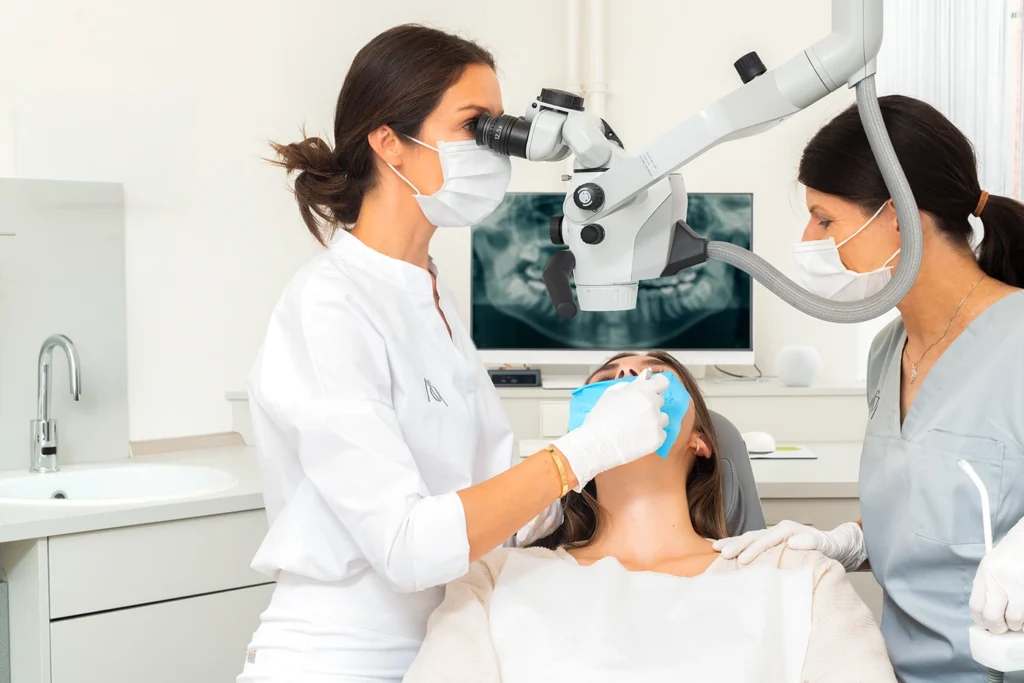
In practice, the difference is clear. Microscopic root canal treatment looks different from the traditional method performed with the naked eye or magnifying glasses. Using the Carl Zeiss surgical microscope, Dr. Indin works at up to 25x magnification. The Coltène CanalPro Jeni, a self-navigating endomotor with torque and apex control, automatically detects the load on the file and stops before it breaks. It does not advance beyond the root tip—thereby eliminating one of the most common causes of endodontic complications. A rubber dam—a thin rubber sheet that isolates the tooth from the rest of the oral cavity—is standard for every treatment. Not out of tradition, but because without this isolation, no root canal can truly be prepared in a sterile manner.
If you’re looking for an endodontics specialist in Offenbach, our practice offers a rare combination: a proven area of expertise, state-of-the-art equipment that far exceeds the standard of a general dental practice, and a commitment to taking the time needed for each individual treatment.
The Root Canal Procedure Process
at Our Practice in Offenbach
At our dental practice in Offenbach, root canal treatment follows a clear procedure that has proven effective for years. We take more time for this than is customary elsewhere—usually one to one and a half hours per session. That is why we do not perform ten root canal treatments a day, but rather a few, done with great care.
Step 1:
Diagnosis and Education.
Every root canal treatment is preceded by a thorough diagnosis. This includes a clinical examination, a vitality test, and an X-ray—sometimes supplemented by a 3D image obtained through an external partner if the anatomy is unclear. We’ll take the time to explain what we see, what the alternatives are, how much the treatment will cost, and what we cannot guarantee.
Step 2:
Local anesthesia and rubber dam.
You will receive a local anesthetic so that the actual treatment is painless. The tooth is then isolated using a rubber dam. The rubber dam protects you from swallowing the irrigation fluid and protects the root canal from bacteria in your saliva and breath. Both of these factors are essential for a successful outcome.
Step 3:
Opening and Preparation.
The tooth is carefully opened. Under the microscope, we locate all the root canals—sometimes there are more than a standard X-ray shows. Using the Coltène CanalPro Jeni, the canals are prepared—that is, cleaned along their entire length and shaped to a specific form.
— Dr. Alessja Indin, Endodontics Fellowship; Specializing in this field since 2015“When I’m working at the microscope, a root canal takes longer than in many other dental offices. That’s my standard. I want to see what I’m doing—not just guess.”
Step 4:
Rinse.
The true core of the treatment is not the drilling, but the irrigation. The canals are disinfected using antibacterial irrigation solutions—including sodium hypochlorite and EDTA, activated by ultrasound. This is the biggest difference between an average root canal treatment and a high-quality one. If the canal isn’t thoroughly irrigated, it won’t heal.
Step 5:
Medicated filling or root canal filling.
Depending on the findings, the tooth is either sealed immediately with a dense root filling or initially treated with a medicated inlay that takes effect over a period of one to four weeks. Only once the tooth is symptom-free and no bacteria are detectable is the final root filling performed using gutta-percha and a biocompatible sealer.
Step 6:
Root canal treatment.
A tooth that has undergone root canal treatment will remain stable in the long term only if it is properly restored afterward—usually with a partial all-ceramic crown, and sometimes with a high-quality composite build-up. This restoration is a separate treatment step and is not part of the root canal treatment itself, but it determines the tooth’s lifespan.
How Long Does a Root Canal Take? Duration, Sessions, and Appointments
The question of how long a root canal treatment takes is one of the most common
—and there’s no single number that can answer it. An honest answer breaks down into three parts.
1.
Duration of a Root Canal Treatment Session
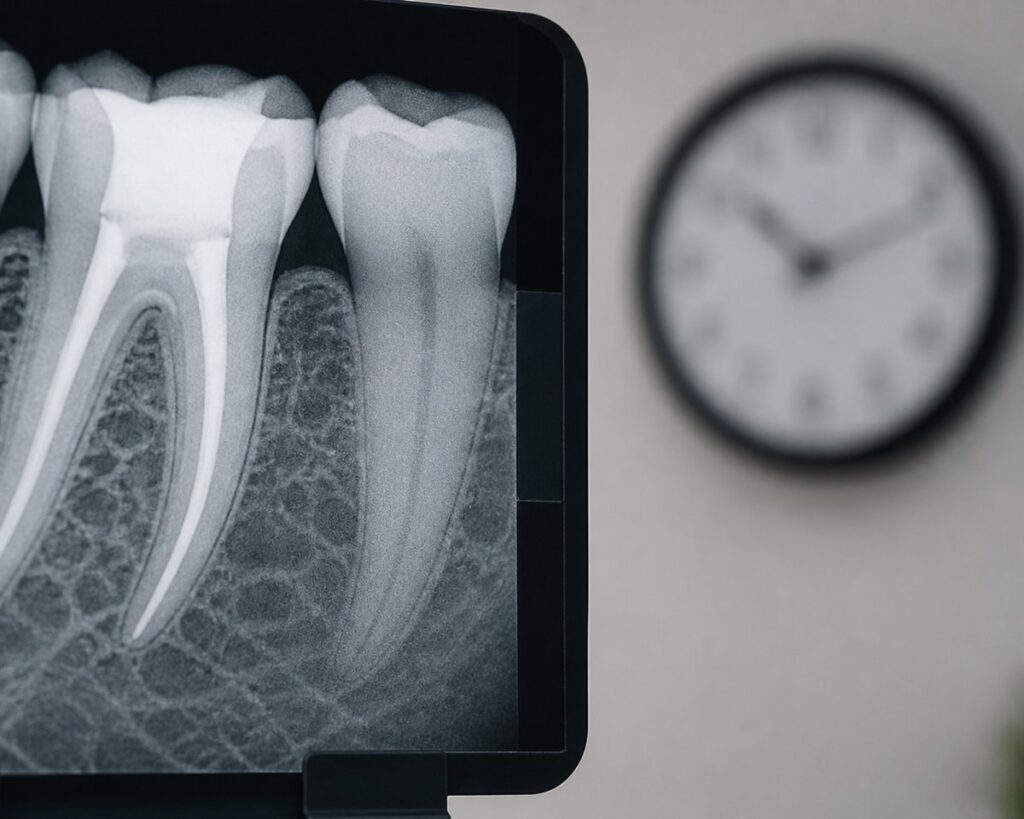
Dr. Indin schedules 60 to 90 minutes per appointment—significantly longer than the 30 to 45 minutes typical in many dental offices. That’s because only under the microscope can you see how many root canals a tooth actually has. Finding hidden canals and carefully opening them takes time. This time is not a matter of convenience, but of safety—because one wrong move can permanently damage the tooth. That is precisely why Dr. Indin deliberately works more slowly than usual at her dental practice in Offenbach.
2.
Number of visits during a root canal treatment
A root canal treatment usually takes two sessions at our practice, or just one in uncomplicated cases. Molars with three or four root canals may require up to three sessions. There is a one- to four-week interval between sessions, during which a medicated filling inside the tooth takes effect. This time is not wasted—it is therapeutically necessary.
3.
Total duration of a root canal treatment
It usually takes six to twelve weeks from the first appointment to the final crown. That may sound like a long time, but it’s only because we respect the body’s natural healing process rather than rushing it.
Root canal treatment for a molar tends to take longer than for an incisor, simply because there are more canals to treat. However, the exact duration depends less on the tooth itself than on the anatomy of the canals. Some are straight and short. Others curve, branch off, or end in lateral canals. That is exactly why we use a microscope.
Does a root canal hurt?
Pain during and after the procedure
Fear of pain is the most common concern associated with root canal treatment—and it’s justified, because many people remember stories from the ’80s and ’90s. Today, things are different.
During treatment, you generally won’t feel anything due to the local anesthesia. In rare cases—such as with very acute inflammation—it can be more difficult to administer the anesthesia. In such cases, we use special anesthesia techniques, such as intraligamentary or intrapulpal anesthesia. We deliberately do not offer general anesthesia or sedation—not because we lack the options, but out of conviction. With a calm demeanor, honest explanations, and a gentle approach, we are able to guide even very anxious patients smoothly through their treatment. Those who suffer particularly severely from dental anxiety can find detailed information about our approach on our page dedicated to treating anxious patients in Offenbach. We do not perform root canal treatments without anesthesia.

After treatment, the tooth may be sensitive to pressure for one to three days. Pain when biting down or a slight throbbing sensation is normal during this phase and can be relieved with common pain relievers such as ibuprofen. It is possible to experience pain after root canal treatment that is worse than before—this is usually due to a temporary increase in inflammation that subsides within a few days. However, if the symptoms do not improve after a week or even worsen, please contact us. This is not necessarily a cause for concern, but it does require further evaluation.
What you can do after treatment: Avoid putting too much pressure on the affected tooth for the first few days, eat soft foods, and avoid alcohol and exercise for 24 hours. In most cases, that’s all you need to do.
Cost of Root Canal Treatment
– Health Insurance, Copayment, Private Coverage
The question of how much a root canal costs almost always leads to the next question: What does health insurance cover, and what do I have to pay out of pocket? An honest answer starts with a distinction.
What Statutory Health Insurance Covers: Root canal treatments on incisors and canines are generally covered by statutory health insurance. For molars, however, coverage is subject to strict criteria—the tooth must be worth preserving in the long term and part of a continuous row of teeth. If any of these criteria are not met, the root canal treatment is considered a purely private service.
What this means in practice: A root canal treatment covered by health insurance is a standard procedure calculated without the use of a microscope, without a comprehensive irrigation protocol, and without the time required for microscope-assisted treatment. We’ll be frank: A root canal treatment of the quality we offer at our practice in Offenbach is not covered by the standard health insurance rate. You will therefore receive a written treatment and cost plan before treatment begins, in which all additional costs are clearly itemized.
Cost Ranges: The out-of-pocket cost for a microscopic root canal treatment—which varies greatly depending on the tooth, the number of canals, and the complexity of the procedure—is usually between 400 and 1,200 euros. A root canal treatment followed by a partial crown or composite filling costs a total of 1,500 to 2,500 euros. Dental supplemental insurance often covers a significant portion of these costs—if you have a policy, we’ll review the terms with you. If paying in installments makes sense, we’d be happy to discuss the options with you.
Microscopic root canal treatment costs more than the traditional method. However, it also has a significantly higher success rate—and an implant costs several times as much.
Root Canal or Tooth Extraction?
An Honest Comparison of the Options
The question of whether to perform root canal treatment or extract a tooth is one of the most difficult in dentistry—and there is no one-size-fits-all answer. The alternative to root canal treatment is, simply put, tooth extraction. This is followed by either a gap, a bridge, or an implant. Which solution is right in each individual case depends on many factors.
The advantage of root canal treatment is that you get to keep your own tooth. Even a tooth that has undergone root canal treatment is still your own tooth—with its own supporting structures, its own sensitivity when biting, and its own aesthetic appearance. No implant can fully replicate a natural tooth.
Arguments against root canal treatment: A tooth that is already severely damaged, with advanced bone loss around it, that has been fractured multiple times, or whose root is already split—such a tooth usually cannot be saved. Root canal treatment would then be an investment with an uncertain outcome. In this situation, it is more honest to recommend extraction early on and discuss the subsequent restoration right away. There is also no hard-and-fast rule when deciding between root canal treatment and an implant: Statistically speaking, properly performed root canal treatments followed by a crown are permanent in over 90 percent of cases. Implants have a similarly high success rate. The best solution is the one that suits your tooth, your bone, and your situation.
— Dr. Alessja Indin, Owner of Dr. Indin & Team, Offenbach"Before I extract a tooth, I try to save it. But I also won't recommend a root canal if the tooth can't be saved anyway. Both approaches are part of the same honesty."
Revision – When a Root Canal Treatment at
Was Unsuccessful
There are cases in which a root canal treatment that has already been performed causes symptoms—sometimes after weeks, sometimes only after years. It is not uncommon for inflammation to persist after a root canal treatment. In such cases, a revision comes into play: a repeat root canal treatment on a tooth that has already been treated.
A root canal revision is more challenging than the initial treatment. The old root filling must be carefully removed without weakening the tooth. Overlooked lateral canals, broken instruments, overlooked main canals—all of these things happen and are often impossible to detect without a microscope. This is precisely where the advantage of microscopic endodontics lies: what becomes visible under the microscope can also be treated.
The success rate of a revision procedure is lower than that of the initial treatment—realistically between 70 and 80 percent, depending on the findings. If the revision is unsuccessful, the next options are apicoectomy (a surgical procedure performed from the outside) or extraction. We discuss all of these options honestly before we begin a revision procedure.
's Frequently Asked Questions About Root Canal Treatment in Offenbach
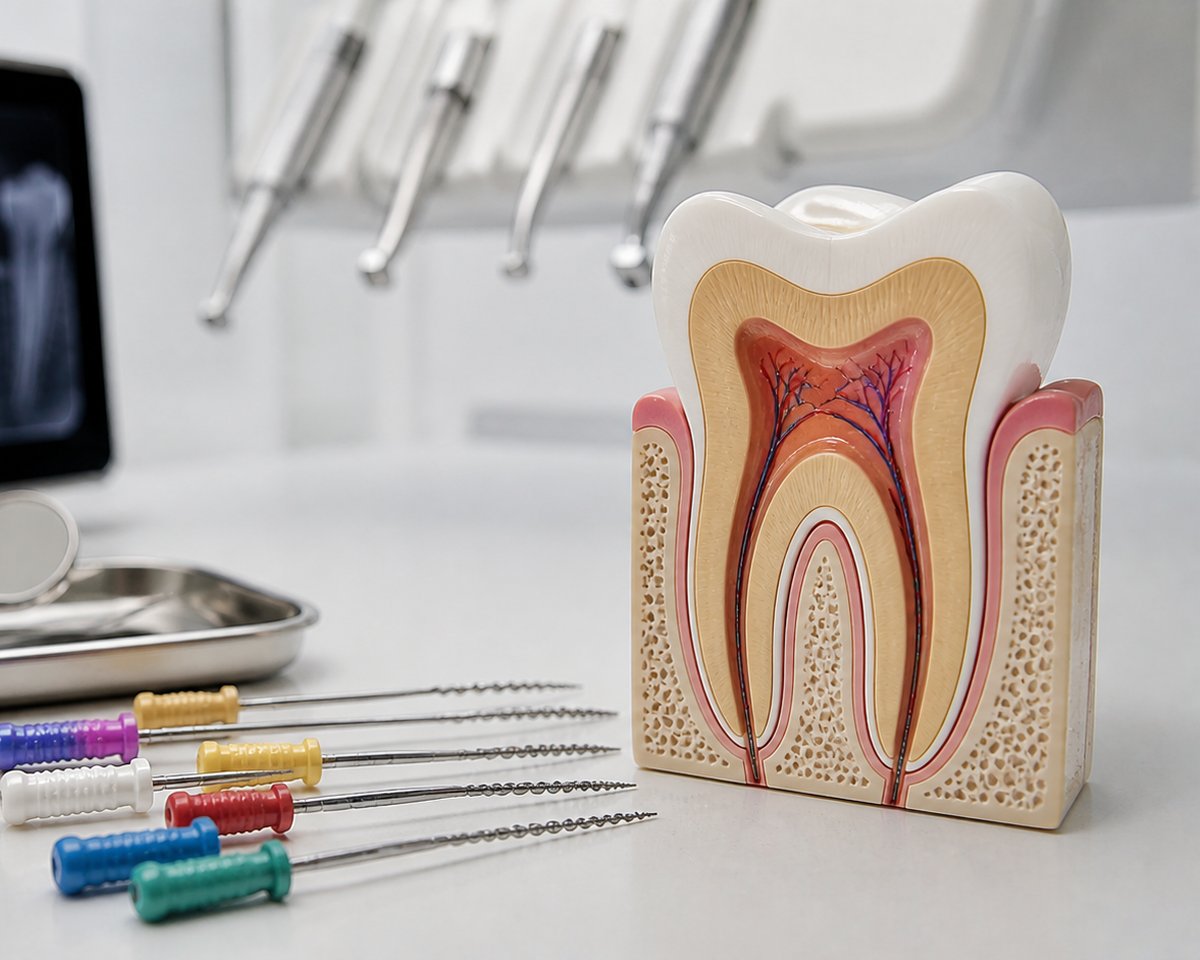
Typical symptoms that indicate the need for a root canal include: throbbing pain that worsens at night, a tooth that reacts excessively to heat or sweets, a dull, pressing pain when biting down, and swelling of the gums. However, there are also cases where root canal treatment becomes necessary even if the patient isn’t experiencing any pain—for example, when a routine X-ray reveals a bright spot at the tip of the root. That’s why preventive checkups are important, even if nothing hurts. At our practice on Ludwigstraße, we make a definitive diagnosis through clinical examination, vitality testing, and X-ray diagnostics.
An irritated tooth nerve can sometimes be soothed in the early stages without the need for root canal treatment. The following measures can help: avoiding cold, hot, or sweet stimuli for a few days; applying external cooling (never hot!); taking pain relievers such as ibuprofen in standard doses; and, above all, seeking prompt evaluation by a dentist. Sometimes, simply removing deep decay and applying a soothing underfilling of calcium hydroxide is enough for the nerve to recover. However, this is only possible if the inflammation hasn’t progressed too far. Anyone experiencing symptoms for more than two to three days should not wait.
A root canal treatment on a molar usually takes two to three sessions of 60 to 90 minutes each at our practice. Molars typically have three to four root canals, and sometimes additional hidden canals that can only be seen under a microscope. It usually takes four to eight weeks from the start of treatment to the final root filling, including the placement of a medicated filling between sessions. The subsequent placement of a crown takes place during a separate phase of treatment.
In the first one to three days after a root canal, the tooth may be sensitive to pressure or feel painful or throbbing when you bite down. This is a normal reaction of the tissue to the procedure and can be effectively relieved with ibuprofen or acetaminophen. Persistent or worsening pain after a root canal treatment—pain that is worse than before the treatment—is rare and always requires further evaluation. Possible causes include a temporarily intensified inflammatory response, a tooth that is too high when biting down, or, rarely, an overlooked root canal. If the pain persists for more than a week or worsens, please contact us immediately.
A microscopic root canal treatment followed by an all-ceramic crown costs between 1,500 and 2,500 euros at our practice, depending on the tooth and the complexity of the procedure. The root canal treatment itself costs between 400 and 1,200 euros, depending on the number of canals, while the all-ceramic crown (IPS e.max) costs approximately 900 to 1,300 euros. The exact total is listed in the treatment and cost plan, which you will receive before treatment begins. Supplemental dental insurance often covers a significant portion of the cost. It is possible to perform root canal treatment under an existing crown, but it costs about the same because the crown must be replaced after treatment.
Statutory health insurance generally covers the full cost of root canal treatment for incisors and canines. For molars, however, coverage is subject to strict criteria—the tooth must be worth preserving in the long term and part of a complete row of teeth. However, microscopic root canal treatment involving a complex irrigation protocol and a rubber dam is an additional service that goes beyond the standard insurance coverage and is billed as a private service. Before treatment begins, you will receive a written treatment and cost plan that transparently lists all out-of-pocket costs.
As long as the anesthesia is still working—usually two to three hours—you should not eat, to avoid accidentally biting your cheek or lip. Once the anesthesia has worn off, you may eat again, but you should avoid putting heavy pressure on the treated tooth for a few days. Soft foods such as soups, pasta, soft vegetables, or yogurt are recommended. A temporary filling will seal the tooth between appointments—you should not chew directly on it, as it is less stable than a permanent filling. Avoid very hard or sticky foods such as caramel, nuts, or chewy candies for 24 hours. You should also avoid alcohol and strenuous exercise on the day of treatment.
According to recent studies, the success rate of a properly performed root canal treatment ranges between 85 and 95 percent. Microscopic root canal treatments yield measurably better results than traditional ones because more canals are identified and cleaned more thoroughly. A tooth that has undergone successful root canal treatment can last a lifetime—provided it is promptly and securely restored with a partial crown or composite filling and that the patient maintains consistent oral hygiene with regular professional dental cleanings. The success rate for retreatment is slightly lower, typically between 70 and 80 percent.
Both terms refer to the same procedure. “Root treatment” is the colloquial, shorter term, while “root canal treatment” is the full technical term. In a medical context, the term “endodontics” is also used. Essentially, the term describes the treatment of the tooth root and its canals: removal of the inflamed nerve, preparation and disinfection of the canals, and a sealed root filling. So if you see different terms on a dental practice’s website, there’s no need to be confused—they all mean the same thing.
Yes, both. We treat anxious patients in Offenbach using a clear approach—no nitrous oxide, no sedation, but plenty of time, detailed explanations, and a step-by-step process. For very anxious patients, the first appointment often consists only of a conversation and a gentle examination. Dr. Indin speaks German, English, and Russian. This allows many patients from the post-Soviet region—including Ukrainians—to communicate in a shared language. This makes a noticeable difference in treatments such as root canal therapy, where clear communication and trust are crucial.