

Dentosophy in Offenbach – Holistic Dentistry with Dr. Indin
Dentosophy treats jaw problems where they originate—not where they become visible. Some misalignments return after every correction; the crowding comes back; the jaw pain persists; and the snoring doesn’t stop. Anyone familiar with this cycle may never have considered the actual cause: the tongue.
At Dr. Indin’s dental practice on Ludwigstraße in Offenbach, dentosophy is one of the core treatment options—an approach that is still relatively uncommon in the region. Dr. Indin completed her training in dentosophy directly at EBTAMED in Italy, where the method was developed.
Table of Contents
What is dentosophy—and what role does the tongue play in it?
Dentosophy is a holistic, functional method that originated from the French-Italian school led by Dr. Rodrigue Mathieu and Dr. Michel Montaud. It combines insights from orthodontics, CMD treatment, and respiratory therapy into an integrative approach—without braces, without the application of active force, and without chemical agents.
A person swallows about 3,000 times a day. When the tongue is in its physiological resting position against the roof of the mouth, it acts like a natural orthodontic appliance: it stabilizes the upper and lower jaws, keeps the dental arch open, and supports nasal breathing. If, on the other hand, the tongue rests in the lower jaw or presses against the teeth when swallowing, it pushes them forward slightly with every swallowing movement—3,000 times a day, for years on end.
Proper tongue position is no small matter. It’s the difference between a stable bite and one that shifts again after every correction. Anyone who breathes through their mouth, whose tongue is positioned incorrectly, or whose swallowing pattern has never evolved beyond that of a child carries within them a root cause that no retainer can permanently correct.
This is exactly where Dentosophy comes in.
Occlusion and Jaw Function—What Really Lies Behind Malocclusions
Gnathology is the science of the masticatory system as a whole: the temporomandibular joints, muscles, occlusion, teeth, and their relationships to one another. A healthy jaw has a defined resting position. The lips are loosely closed, the tongue rests against the palate, and there is a small gap between the teeth. This normal jaw position is not a coincidence, but the result of a well-functioning interplay of factors.
When this interplay is disrupted, simply straightening the teeth is often not enough. Stomatology—the study of the oral cavity as a system—has recognized this connection for decades. The teeth are the result of a function—not its cause. A malocclusion that is not corrected at its root cause will inevitably lead to a relapse.
Dentosophy focuses on function. Only when swallowing, breathing, and chewing occur in a physiologically correct manner can the result be permanently stable.
Who Is Dentosophy Suitable For? – An Overview of Indications
This method is suitable for both children and adults. Conditions treated include:
- Deep bite, crossbite, open bite
- Narrow dental arch and insufficient space for the teeth
- Protrusion or retrusion of the lower jaw
- Mouth Breathing
- Abnormal Swallowing Pattern
- Teeth Grinding and Clenching
- TMJ symptoms such as headaches, muscle tension, and temporomandibular joint problems
- Snoring and nocturnal breathing disorders
- Postural Problems Related to the Jaw
Whether you want to correct a misaligned jaw without surgery, finally understand the root cause of bruxism, or have experienced a relapse after orthodontic treatment—Dentosophy asks different questions than traditional dentistry.
This method is not an alternative to traditional orthodontics. It serves as a functional preparatory step for traditional orthodontics—or, in cases where braces are not an option, as a standalone solution.
Dentosophy in Offenbach – Dr. Indin and Her Training at EBTAMED
Dr. Indin completed her training in Dentosophy directly at EBTAMED in Italy—where the method was developed. She also received additional training from Dr. Christine Wagershausen, who introduced the method to the German-speaking world.
Dentosophy did not come into her life through a textbook. When her daughter developed a lateral crossbite and traditional orthodontics failed to provide a satisfactory solution, her search for a real solution led her to Dentosophy. Dr. Indin tested the Equilibrator on her own children and on herself. A lifelong incorrect swallowing pattern was corrected within three months—without speech therapy and without time-consuming exercises.
The practice at Ludwigstraße 34, in the heart of downtown Offenbach, offers Dentosophy based on thorough training. Patients from Offenbach, Frankfurt, Neu-Isenburg, Dreieich, Mühlheim am Main, and the entire region will find a treatment approach here that is rare in this form.
This treatment is a self-pay service. The total cost for a full course of therapy over two years is approximately 2,000 to 3,000 euros. A transparent cost breakdown will be discussed before therapy begins.
— Dr. med. dent. Alessja Indin, Dentosophy training at EBTAMED, Italy“Dentosophy has changed me as a dentist. Not because I learned a new technique, but because I’ve come to understand why so many problems keep coming back.”
The Correct Resting Position of the Tongue—and What Happens When It's Incorrect
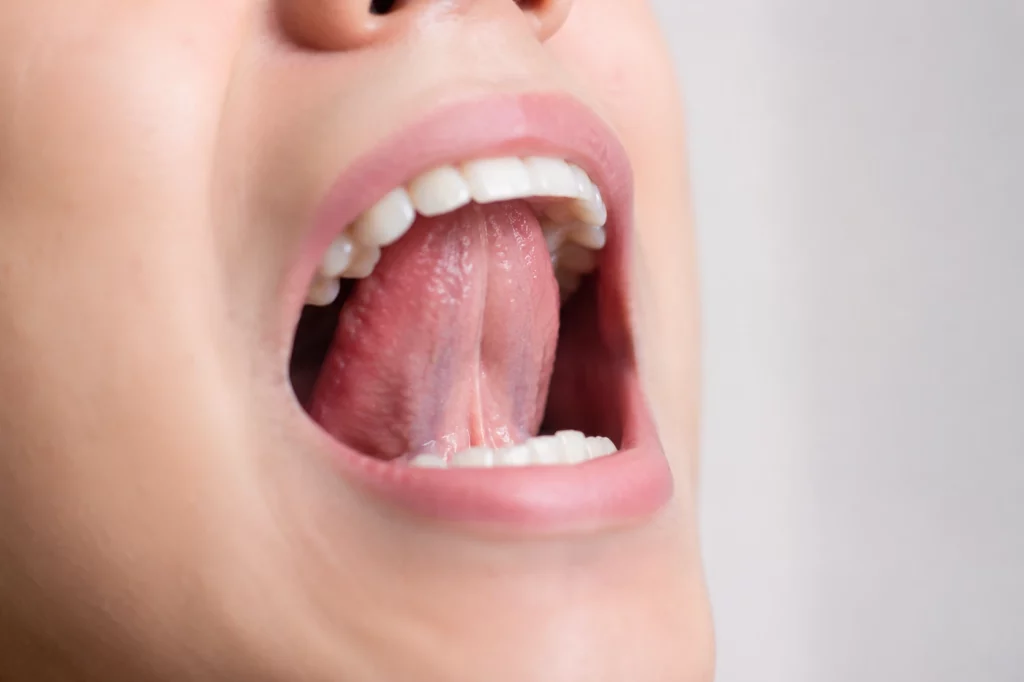
The tongue has a fixed position in the mouth. When relaxed, the tip of the tongue rests slightly behind the upper incisors on the roof of the mouth—not on the floor of the mouth, not pressed against the teeth, and not hanging limply in the lower jaw. This spot on the roof of the mouth is called the tongue’s resting position. When the tongue is positioned there, a person breathes through the nose, the dental arch remains open, and the jaw muscles relax.
An incorrect resting position of the tongue looks different. The tongue rests on the lower jaw, presses against the front teeth, or falls forward when swallowing. Some people don’t realize until they undergo a diagnostic evaluation that their tongue has been in the wrong position for decades—and that this is precisely why their teeth keep shifting despite wearing a retainer.
Many people describe the feeling as if their tongue were too big for their mouth. In most cases, the tongue isn’t too big—it just hasn’t learned where it belongs. A tongue that rests permanently on the lower jaw appears wider and fuller than one that rests against the roof of the mouth and helps define the space.
Chewing is also affected. People who chew with their mouths open or press their tongues against their teeth when swallowing activate incorrect muscle patterns that, over the years, extend into the temporomandibular joints and the cervical spine. Learning to chew as an adult may sound unusual—but it is a real component of functional therapies.
The good news: You can train your tongue to maintain its resting position. The Equilibrator supports this process by helping the body achieve the correct starting position at night and during daily exercise sessions. In addition, there are specific tongue exercises that Dr. Indin provides to her patients in writing. In practice, training the correct tongue position means: developing awareness of the tongue’s position, consciously placing the tip of the tongue against the roof of the mouth every day, correctly forming certain sounds—such as the “s”—with the tip of the tongue, and gradually transitioning the swallowing pattern from a visceral to a somatic pattern.
This process takes time. But it leaves no lasting effects—once you stop, you simply return to your original state.
The Equilibrator – How the Treatment Works
The central device used in Dentosophy is the Equilibrator, also known as the Balancer. It is made of a soft, flexible, rubber-like material—similar to a mouthguard, but significantly smaller and lighter. The device is placed between the rows of teeth and worn in the mouth: at night while sleeping and during the day for about an hour and a half, preferably in a quiet setting while reading or relaxing. In addition, a five-minute exercise session is performed each day.
The Equilibrator does not work by applying pressure or tension. It creates the conditions under which the body finds its own physiological neutral position. The three key functions it trains and supports are swallowing, breathing, and chewing. When these three basic functions operate correctly, the entire masticatory system regulates itself over time.
Follow-up appointments take place every three months. The device is replaced approximately every six months, either because it has worn out or because a customized version better supports the patient’s progress in therapy. The total duration of therapy is typically two years.
The devices come directly from EBTAMED—the very place where Dr. Indin received his training.
Diagnosis Before Treatment—What Dr. Indin Examines Before Using the First Device
Before an Equilibrator is fitted, a thorough evaluation is conducted. Dr. Indin examines the position and resting position of the tongue, the length and mobility of the lingual frenulum, the swallowing pattern, breathing, and the movement of the nostrils.
In addition, a posturological test is performed: The patient stands in front of the measuring wall in the office, and a photograph of their posture is taken. Any misalignments, shoulder height, and head tilt are documented and serve as the baseline for monitoring the course of therapy. A growth pattern analysis using a ruler-based measurement system on the ear completes the diagnostic evaluation.
If a shortened lingual frenulum prevents the tongue from resting naturally against the roof of the mouth, Dr. Indin can perform the frenotomy right in his office—using an electrotome, with minimal bleeding and good healing results. Patients do not need to go to another office for this procedure.
In more complex cases, Dr. Indin works in an interdisciplinary manner with physical therapists and osteopaths.

— Dr. med. dent. Alessja Indin, Dentosophy training at EBTAMED, Italy“Before I adjust an appliance, I want to understand why the problem exists. Tongue position, tongue tie, swallowing patterns, breathing, posture—these aren’t just additional details. They are the actual diagnosis. Anyone who skips this step is just treating the symptoms.”
Dentosophy Instead of Orthodontics—or Both?
Dentosophy does not compete with traditional orthodontics. It addresses a problem that orthodontics alone cannot permanently resolve: the root cause.
If the teeth are straightened but the patient continues to breathe through the mouth or presses the tongue against the front teeth when swallowing, the teeth will shift back to their original position after treatment is complete. Retainers can slow this down, but they cannot stop it.
Dentosophy addresses swallowing patterns, the resting position of the tongue, and respiratory function—in other words, the forces that shape the dentition on a daily basis. As a functional preparatory step before orthodontic treatment, it significantly improves the stability of the treatment. As a standalone method, particularly for children ages five and older, it can often correct malocclusions before braces are even considered.
In many cases, jaw correction is possible without surgery. A consultation will determine whether dentosophy is the right method for your specific case—either on its own or in combination with other treatments.
Schedule a Consultation – Dentosophie in Offenbach
Are you in Offenbach, Frankfurt, Neu-Isenburg, Dreieich, or the wider Rhine-Main region and would like to know if Dentosophy is a good fit for you or your child? Then it all starts with a relaxed conversation at our practice at Ludwigstraße 34 in downtown Offenbach—easily accessible by S-Bahn and just a few minutes’ walk from Offenbach Central Station.
No time pressure, no obligations. Dr. Indin’s practice operates strictly by appointment—you’re welcomed, not rushed.
Frequently Asked Questions About Dentosophy in Offenbach

Dentosophy is a functional method of equilibrium dentistry that treats the root causes of malocclusion, swallowing patterns, breathing function, and temporomandibular joint problems. It originated in the Franco-Italian school and uses the Equilibrator, a soft device that physiologically realigns the three central oral functions—swallowing, breathing, and chewing. The basic principle: Many jaw problems are not caused by the teeth themselves, but by incorrect muscle patterns that have become ingrained over the years. Dentosophy corrects these patterns rather than merely treating their consequences.
Dentosophy is a functional method of equilibrium dentistry that treats the root causes of malocclusion, swallowing patterns, breathing function, and temporomandibular joint problems. It originated in the Franco-Italian school and uses the Equilibrator, a soft device that physiologically realigns the three central oral functions—swallowing, breathing, and chewing. The basic principle: Many jaw problems are not caused by the teeth themselves, but by incorrect muscle patterns that have become ingrained over the years. Dentosophy corrects these patterns rather than merely treating their consequences.
If the tongue rests on the lower jaw instead of the roof of the mouth, it presses against the teeth when swallowing—about 3,000 times a day. Over months and years, this leads to misaligned teeth, crowding, and relapse after orthodontic treatment. Mouth breathing, snoring, and temporomandibular joint problems can also result from a chronically incorrect resting position of the tongue. A healthy tongue, when viewed from below, shows a relaxed lingual frenulum and good mobility—both of which Dr. Indin checks during the initial diagnostic evaluation.
In the physiological, somatic swallowing pattern, the tongue presses against the palate. In the visceral, infantile swallowing pattern, it presses against the teeth. All infants swallow this way—it’s normal. It becomes problematic when this pattern carries over into adulthood. Anyone who retains the childlike swallowing pattern exerts pressure on their front teeth with each of the approximately 3,000 swallows they make every day. Dentosophy specifically retrains the swallowing pattern—using the Equilibrator as an aid and simple daily exercises that Dr. Indin provides to her patients in writing.
The tongue is much more than just an organ of speech. When swallowing, it generates the pressure that shapes the jaw every day. It keeps the dental arch open when it rests against the palate. It also helps control breathing—people whose tongues rest low often breathe through their mouths instead of their noses. And it influences posture: jaw position and head posture are directly linked via the muscle chains of the neck. In Dentosophy, the tongue is therefore the most important starting point for any diagnosis.
Yes, and that’s one of the most common misconceptions about the method. Many people view Dentosophy as a therapy for children—but in fact, the body responds to functional stimuli at any age. Dr. Indin experienced this firsthand: An incorrect swallowing pattern she’d had since childhood was corrected within three months using the Equilibrator—without speech therapy or time-consuming exercises. The duration of therapy may be slightly longer for adults than for children, whose jaws are still growing. This does not affect the effectiveness of the method.
In many cases, yes, if the cause is functional. Non-surgical jaw correction using Dentosophy is possible in cases where malocclusions have developed or been exacerbated by an incorrect swallowing pattern, mouth breathing, or an incorrect resting position of the tongue. Diagnostic testing will determine whether this applies to the specific case. Severe skeletal malocclusions may still require surgical intervention in some cases. In such cases, Dentosophy stabilizes function and prevents recurrence.
Gnathology is the science of the masticatory system as a whole: the temporomandibular joints, muscles, occlusion, and teeth in their interaction. A healthy jaw has a defined resting position—lips loosely closed, tongue against the palate, and a small gap between the teeth. If this balance is disrupted, problems arise that cannot be permanently resolved through orthodontic treatment alone. Gnathology is the scientific foundation of Dentosophy. Treatment with Dr. Indin therefore always begins with a gnathological evaluation. Gnathological services are generally not covered by state health insurance plans.
Dr. Indin’s practice is located at Ludwigstraße 34 in downtown Offenbach, about a seven-minute walk from the Offenbach Central Station. It is easily accessible from Frankfurt, Neu-Isenburg, Dreieich, Mühlheim am Main, and the entire Rhine-Main region. The practice operates strictly by appointment—each appointment has its own time slot, so there is no waiting room. Anyone looking for a holistic dentist in Offenbach who combines functional dentistry and dentosophy with a solid educational background will find this approach here.
A complete two-year Dentosophy therapy program at Dr. Indin’s practice costs between 2,000 and 3,000 euros. This includes all follow-up appointments, the Equilibrator, and any device replacements during the course of treatment. This is significantly less than what many providers charge for comparable services. The treatment is a self-pay service and is generally not covered by state health insurance plans. Before starting therapy, you will receive a transparent cost estimate—so you know what to expect before making a decision.