
Dental Implants in Offenbach – When a Tooth Is Missing and You’re Looking for a Real Solution
A dental implant does more than simply replace a missing tooth. It replaces it right down to the root—in terms of function, stability, and substance. When you lose a tooth, you also lose something that affects your chewing, speech, and jaw development. The implant is the only treatment that truly compensates for all of this—while leaving the adjacent teeth completely undisturbed.
At Dr. Indin’s dental practice on Ludwigstraße in Offenbach, the entire treatment process is handled under one roof: from the initial examination to the placement of the implant and the final crown. For patients from Offenbach, Frankfurt, and the entire Rhine-Main region.
Table of Contents
What is a dental implant?
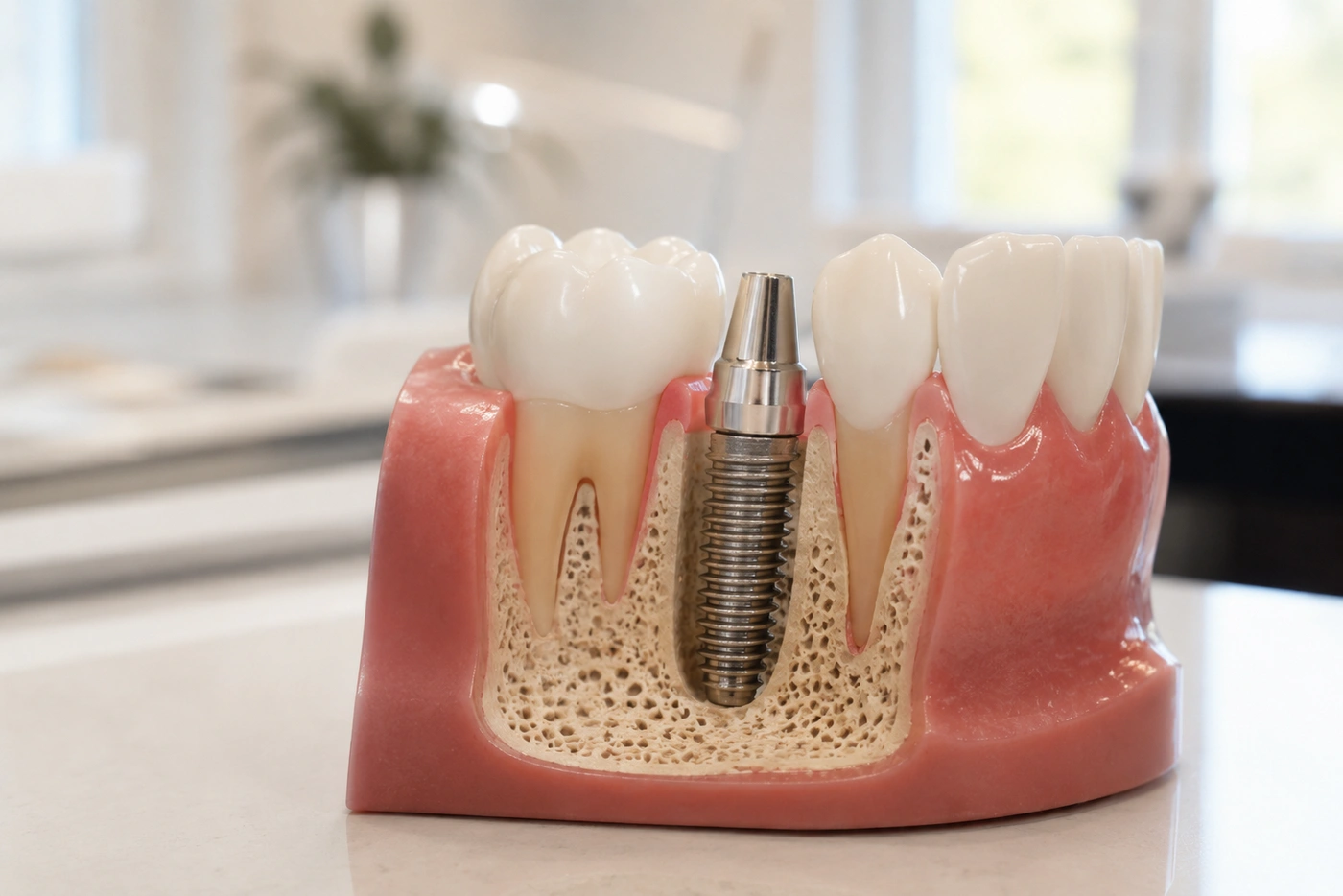
A dental implant is an artificial tooth root made of titanium that is surgically inserted into the jawbone. Over the course of several months, it fuses firmly with the bone—a process known in medicine as osseointegration. An abutment is then attached to this stable foundation, followed by a crown.
The result is a tooth that is firmly in place, feels just like a natural tooth, and functions the same way. Unlike a bridge, the implant does not come into contact with the adjacent teeth. They do not need to be ground down or used as abutments. That is the key difference—the tooth structure remains intact.
Dental Implant Process – From the Initial Examination to the Final Crown
Before an implant is placed, a diagnostic evaluation is performed. Dr. Indin assesses the available bone, the position of the maxillary sinus and the nerve canal, as well as the overall oral condition. To measure bone volume, an X-ray with a measuring sphere is taken; in complex cases, a CBCT scan is coordinated with external partners.
Step 1:
Consultation and Diagnosis:
You’ll learn what’s possible, how much the treatment will cost, and what it can’t guarantee. How much bone is present? What treatment makes sense? What is realistically achievable? These questions will be answered before anything begins. No step is taken without a clear, shared understanding.
Step 2:
Extraction:
If the tooth is still present, Dr. Indin extracts it himself—with an eye toward the future condition of the bone. This is not a routine procedure. The way a tooth is removed helps determine how much bone is preserved—and thus the conditions necessary for the implant.
Step 3:
Recovery phase:
The bone heals—typically over three months. During this time, you will receive a temporary restoration, free of charge and aesthetically pleasing, in both the anterior and posterior regions. This phase can be used to address any outstanding questions or to finalize the color of the permanent crown.
— Dr. med. dent. Alessja Indin, owner of the Dr. Indin & Team dental practice in Offenbach am Main“I want to extract the tooth, place the implant, and ultimately make the crown as well. Those who only perform implant surgery often aren’t familiar with the prosthetic requirements that follow—and therefore don’t plan ahead accordingly.”
Step 4:
Placing the implant:
The implant is inserted with precision—using the smallest suitable drill bit, under magnification with loupe glasses, and with a tight wound closure. The procedure usually takes less than an hour and is performed under local anesthesia. What you feel is pressure—not pain.
Step 5:
Healing, gingival formers, and scan
Three months, during which the implant fuses with the bone. After that, the gingiva former is inserted, and the gum tissue is shaped. A digital impression is taken using the Medit i900 intraoral scanner—precisely, without impression material.
Step 6:
Root canal treatment.
The dental lab custom-fabricates the permanent crown. It is placed, the bite is checked, and final adjustments are made. The tooth is ready—and fits as if it had never been gone.
From extraction to the finished crown: six to eight months. All in the same dental office, with the same dentist.
Dental Implants in Offenbach – Why Choose Dr. Indin
Implantology is a field in which the quality of planning is just as important as the quality of the procedure. At our practice in Offenbach-Westend, everything is handled under one roof—from diagnosis to follow-up care.
- Titanium implant systems from Straumann and Dentsply Sirona OmniTaper EV, ceramic implants from SDS (Swiss Dental Solutions)—trusted manufacturers known for high primary stability and reliable healing
- Magnifying glasses as standard—every procedure is performed under optical magnification
- Everything under one roof—extraction, implantation, crowns, and follow-up care provided personally by Dr. Indin
- Unconditional warranty—if an implant does not integrate, the treatment will be repeated free of charge, even for smokers
- Appointment-Based Practice – No Waiting, Ample Time Per Appointment
- Multilingual – Treatment in German, English, and Russian
The practice is located in the historic building at Ludwigstraße 34, featuring high ceilings, plenty of natural light, and an atmosphere that regularly surprises patients. It is near the Offenbach Chamber of Commerce and Industry and is easily accessible from the main train station.
Dental Implant Costs – How Much Does an Implant Cost in Offenbach?

The cost of a dental implant consists of several components: the implant itself, the prosthetic abutment, and the crown. Depending on the patient’s initial condition, bone grafting may also be required. An implant in the molar region generally falls within a different price range than one in the front teeth region.
Public health insurance covers a fixed subsidy for dental prosthetics, but not the cost of the implants themselves. Depending on their plan, privately insured patients are entitled to higher reimbursements. Before treatment begins, the dental practice provides a complete cost estimate—transparent, easy to understand, and with no hidden charges.
For more complex treatments, we’re happy to discuss individual payment options upon request—just let us know.
Implant or Bridge—Which Is Right for Which Situation?
Both types of restorations can replace a missing tooth. The difference lies in how they affect the adjacent teeth.
A bridge requires abutment teeth. These are ground down—even if they are healthy. This is an irreversible procedure. An implant does not require abutment teeth. It stands on its own, protects the bone from resorption, and leaves the adjacent tooth structure intact.
In most cases, an implant is the solution that preserves more natural tooth structure and offers greater long-term stability. Whether it is the right choice in a specific case depends on the amount of available bone, the patient’s overall health, and their personal situation. Dr. Indin provides an honest assessment—even when an implant is not the best option.
Bone Regeneration—When the Necessary Conditions Must First Be Established
If you have been missing a tooth for a long time, you will eventually lose jawbone as well. The same is true after periodontitis or a difficult extraction. In these cases, bone grafting is necessary before an implant can be placed.
In practice, there are three methods available for this:
- Internal sinus lift—for vertical bone deficiency in the upper jaw; the bone graft material is inserted through the implant site without making an incision in the face. This procedure is significantly less invasive than the external method, which we have deliberately chosen not to offer here.
- Bone Split – for horizontal bone deficiency; the existing bone ridge is split and widened so that even a jaw that was originally too narrow can be treated.
- PRF Autologous Blood Procedure – Growth factors derived from the patient's own blood are used to promote healing.
How long you need to wait after having a tooth extracted depends on your individual healing process. Three months is typical.
— Dr. med. dent. Alessja Indin, owner of the Dr. Indin & Team dental practice in Offenbach am Main“I don’t place implants if the conditions aren’t right. Speed sounds good—but an implant that doesn’t heal properly costs the patient more than just money.”
Dental Implant Materials—Titanium, Ceramic, and What the Systems Can Do
For titanium implants, the practice relies on systems from Straumann as well as the Dentsply Sirona OmniTaper EV—the proven successor to the Astra Tech system. A proven clinical design and material quality backed by many years of experience ensure reliable osseointegration and high stability upon placement.
For decades, titanium has been the best-documented material for dental implants—it is biocompatible, durable, and has been proven time and again in large-scale long-term studies.
For patients seeking metal-free restorations, the practice offers zirconia ceramic implants from SDS (Swiss Dental Solutions). For titanium implants, the practice uses systems from Straumann and the Dentsply Sirona OmniTaper EV. Both materials are proven over the long term and biocompatible—the choice depends on the clinical situation and the patient’s preferences.
Peri-implantitis – Know the Risks, Take Follow-Up Care Seriously
Peri-implantitis is an inflammation of the tissue surrounding a fully integrated implant. It is usually caused by poor oral hygiene, but can also be exacerbated by smoking or systemic diseases. Symptoms include red, bleeding gums and the formation of pockets—in advanced stages, bone loss around the implant may occur.
The most important measure is consistent follow-up care: regular professional teeth cleaning, good oral hygiene at home, and follow-up appointments at the dental office. Dr. Indin prescribes antibiotics only when they are truly medically necessary. Routine prophylactic use, as is common in some dental offices, is deliberately avoided here.
Implantation is generally possible for smokers and patients with well-controlled diabetes. The warranty remains valid regardless.

How long does a dental implant last?
Dental implants are among the most durable restorations in modern dentistry. Long-term studies show success rates of over 95 percent after ten years. Key factors include planning, the implant system, surgical precision, and consistent follow-up care.
Here’s what Dr. Indin adds from his clinical experience: If an implant does not integrate, the treatment is repeated at no cost—no additional out-of-pocket expense, no questions asked. The patient has made an investment. That is recognized.
Request a consultation – on Ludwigstraße in Offenbach
The Dr. Indin & Team practice is located at Ludwigstraße 34 in Offenbach-Westend, near the Offenbach Chamber of Commerce and Industry (IHK), and is easily accessible from the Offenbach am Main main train station. As an appointment-only practice, we operate without wait times and allow ample time for each appointment.
Consultations and treatment in German, English, and Russian.
Frequently Asked Questions About Dental Implants in Offenbach
The cost of a dental implant in Offenbach consists of several components: the implant itself, the prosthetic abutment, and the crown. In addition, if necessary, there are costs for bone grafting, which may be required in some cases prior to implantation. The exact total can only be determined after a clinical examination and X-ray evaluation—general price estimates provided without diagnostic findings are unreliable. At Dr. Indin’s practice, patients receive a complete, transparent cost estimate listing all items individually before treatment begins. For more complex procedures, we are happy to discuss individual payment arrangements upon request.
In the molar region, the cost of a dental implant is generally slightly higher than in the front teeth region, as larger implants and more stable crowns are required. Statutory health insurance covers a fixed subsidy for the dental restoration —that is, for the crown or bridge—but not for the implant itself. Depending on the status in your bonus booklet, this subsidy ranges from about 35 to 65 percent of the fixed subsidy amount. Privately insured patients should review the specific terms of their policy, as reimbursement rates vary significantly depending on the plan. At Dr. Indin’s practice, the expected out-of-pocket cost for each specific case is discussed transparently during the consultation.
It usually takes six to eight months from extraction to the finished crown—though it may take a little longer if bone grafting is necessary. The actual placement of the implant typically takes less than an hour. The longest phase is the biological healing process within the bone, known as osseointegration—this typically takes three months. This is followed by gingival contouring, a digital scan, and the fabrication of the permanent crown by the laboratory. Throughout the entire treatment period, patients at Dr. Indin’s practice receive a free temporary restoration to ensure there is no aesthetic gap.
In most cases, it is recommended to wait about three months after extraction to allow the bone to heal completely and regenerate. During this time, new bone tissue forms, creating the conditions necessary for a stable implant. In certain situations—such as when the tooth was removed atraumatically and there is sufficient bone—earlier or even immediate implantation is possible. Dr. Indin generally advises against immediate implantation, as the risk of implant loss is higher in a freshly extracted wound contaminated with bacteria. A clinical examination and X-ray diagnostics will determine which option is appropriate in each specific case.
In most cases, a dental implant is the solution that preserves the most tooth structure: the adjacent teeth do not need to be ground down or used as bridge abutments. In addition, the implant actively protects the jawbone from resorption, which inevitably begins after tooth loss. A bridge may be a good option if there isn’t enough bone for an implant, if adjacent teeth need to be treated anyway, or if the patient prefers a shorter treatment duration. Both options have their merits—the key factor is the individual situation. Dr. Indin provides an honest assessment, even if an implant isn’t the best solution in a specific case.
Peri-implantitis is a bacterial inflammation of the tissue surrounding a fully integrated implant—similar to periodontitis affecting a natural tooth. It is usually caused by poor oral hygiene, but can be exacerbated by smoking, diabetes, or other systemic diseases. Symptoms include red, bleeding, or swollen gums, as well as the formation of pockets; in advanced stages, there is a risk of bone loss around the implant. The most important preventive measure is consistent follow-up care: regular professional teeth cleaning, good at-home oral hygiene, and follow-up appointments at the dental office. At Dr. Indin’s practice, antibiotics are used only when medically indicated—routine prophylactic administration is deliberately avoided.
Dental implant placement is performed under local anesthesia—so the procedure itself is generally painless. What patients feel during the procedure is pressure and vibration, not pain. Many report afterward that the procedure was significantly less stressful than they had expected. In the first few days after implantation, mild swelling and a sensation of pressure may occur, which usually subside quickly. Severe or persistent pain after the procedure is unusual and should be discussed with the practice as soon as possible. Patients with dental anxiety are expressly welcome at Dr. Indin’s practice—the treatment is explained step by step before it begins.
For titanium implants, the practice relies on systems from Straumann as well as the Dentsply Sirona OmniTaper EV, the direct successor to the well-known Astra Tech system. For decades, titanium has been the best-documented material for dental implants—it is biocompatible, durable, and has been proven time and again in large-scale long-term studies. For patients who prefer a metal-free restoration, the practice offers zirconia ceramic implants from SDS (Swiss Dental Solutions). During the consultation, we will discuss together which system is best suited to your individual situation.
Yes, even smokers can get a dental implant. Smoking increases the risk of healing problems because nicotine reduces blood flow to the tissue and can impair osseointegration—but it is not a general exclusion criterion. At Dr. Indin’s practice, we openly and specifically explain during the consultation what smoking means for the healing phase. Experience has shown that most patients cut back on or stop smoking once they truly understand the implications. The guarantee applies to smokers as well: If an implant fails to integrate, the treatment will be repeated at no cost—no additional out-of-pocket expense, no questions asked.
Dental implants are among the most durable restorations in modern dentistry. Long-term studies show success rates of over 95 percent after ten years—with proper care and regular follow-up, implants can last for many decades. Key factors affecting longevity include the quality of planning, the implant system used, surgical precision during placement, and consistent follow-up care with regular professional teeth cleaning. Factors such as smoking, diabetes, or poor oral hygiene can shorten their lifespan. At Dr. Indin’s practice, the policy is: If, despite all efforts, an implant fails to integrate, the treatment will be repeated free of charge.