
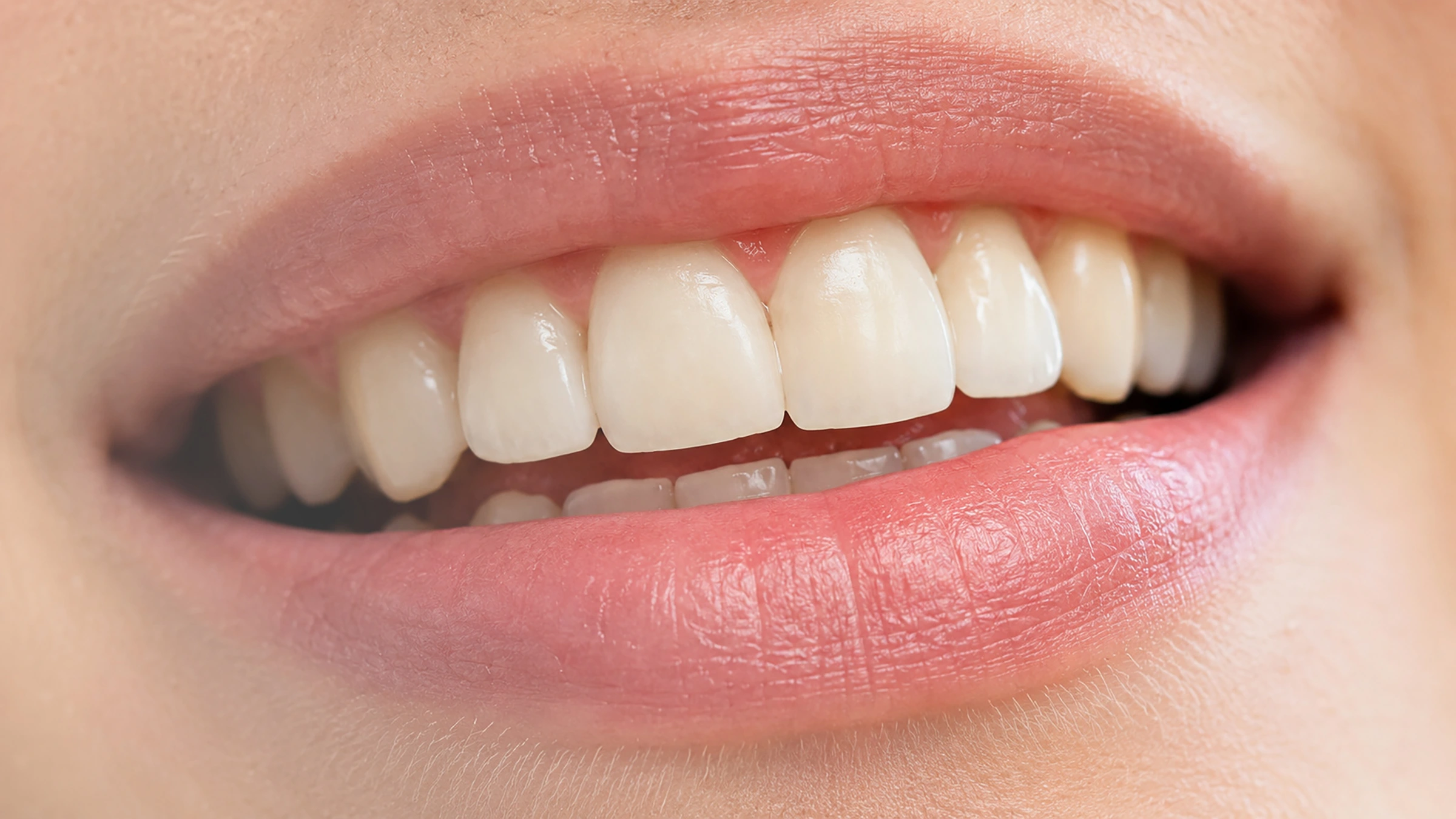
Teeth Whitening: 6 Factors That Determine Your Whitening Results
The desire to have teeth whitened is one of the most common requests in my practice—and hardly any other topic comes with such a wide range of expectations. Some patients come in with a very specific image in mind, while others have no idea what to expect. And almost always, after the initial consultation, it becomes clear that the result depends on six factors that neither I nor the system can fully control. I’m Dr. Alessja Indin, a dentist and the owner of the practice on Ludwigstraße in Offenbach—and I’d like to explain here what these factors are and how you can contribute to the process yourself.
Table of Contents
Factor 1 – The initial tooth color determines how effective teeth whitening can be
Not all teeth are the same. The natural color of teeth is determined by genetics—some people are born with light-colored teeth, while others have darker ones. This is not a matter of oral hygiene, but of dental biology.
When it comes to teeth whitening, this means that people who start with a yellowish base color will generally see more noticeable results than those whose teeth are naturally grayish. Yellow stains respond better to hydrogen peroxide than gray ones. This is because gray stains are often deeper within the tooth structure and result from different causes.
Realistically speaking, this means that teeth whitening does brighten teeth—but it doesn't completely change their underlying genetic color. If you know this, you'll be more satisfied with the results of the treatment.
Factor 2 – Enamel Structure and Teeth Whitening: A Personalized Approach
Tooth enamel is not structured the same way in everyone. Porous enamel absorbs the bleaching agent differently than dense, compact enamel. Microcracks, enamel defects, or fluorosis can affect the results—sometimes positively, sometimes less so.
That is precisely why every teeth-whitening treatment at our practice begins with a preliminary examination. Not as a mere formality, but as a necessary assessment of the actual condition of the teeth. Teeth whitening applied to a poorly prepared surface rarely achieves the results that would otherwise have been possible.
By the way, if you have sensitive teeth, that doesn't have to be a deal-breaker. It just means that the preparation has to be more thorough—and that the system plays a role. Factor 6 comes into play here as well.
Factor 3 – Type and Age of Stains When Whitening Teeth
Not all discoloration is the same. Dentists distinguish between extrinsic discoloration—that is, discoloration caused by external factors—and intrinsic discoloration, which originates deep within the tooth structure.
Extrinsic stains caused by coffee, tea, red wine, or tobacco generally respond well to teeth whitening. These stains are closer to the surface and can be effectively lightened with hydrogen peroxide.
Intrinsic discoloration caused by tetracycline antibiotics, dental trauma, or dead dental nerves is more difficult to treat. These discolorations are deeper, have been present longer, and require either more sessions or a different method—such as internal bleaching for teeth that have undergone root canal treatment.
The longer a stain has been present, the deeper it has penetrated the tooth structure. A fresh coffee stain reacts differently than a stain that’s been there for twenty years. This isn’t meant to discourage you—it’s a realistic assessment.
Factor 4 – Teeth whitening does not affect dental prostheses
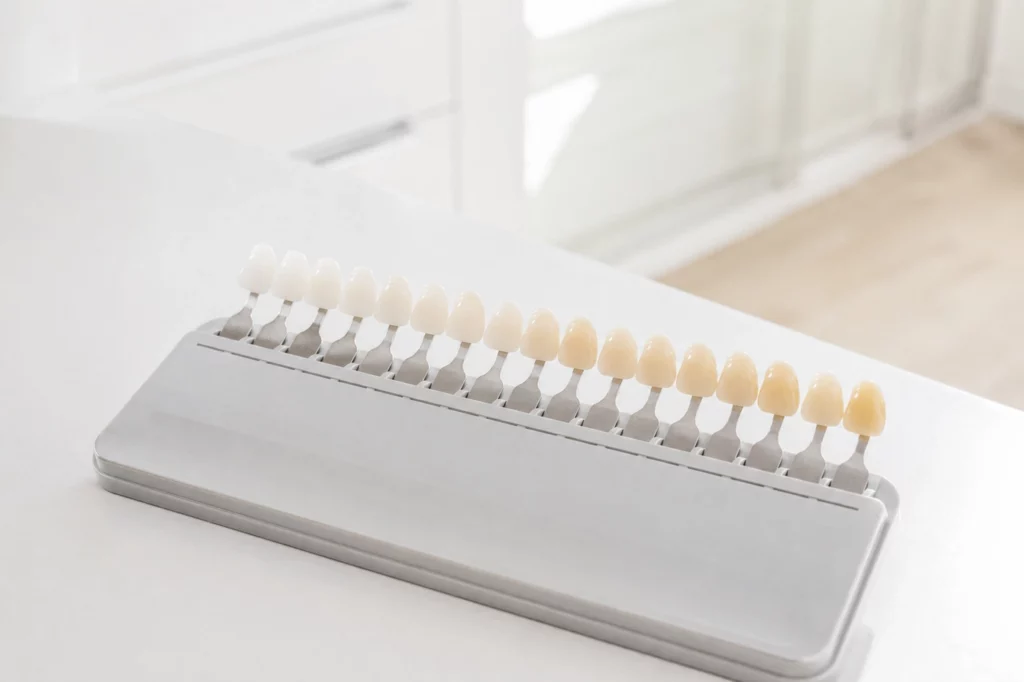
This factor is most often overlooked during consultations—not by the patient, but by the dentist. Crowns, veneers, composite fillings, and implant crowns do not respond to bleaching agents. They retain their original color, no matter how many sessions are performed.
This isn't a system error. It's just the nature of the material. But here's what it means: If you have dental restorations in the visible front teeth area, you need to discuss this with your dentist before undergoing teeth whitening. Otherwise, the result will be that your natural teeth become whiter, while the restorations remain their original color. That will be noticeable.
— Dr. med. dent. Alessja Indin, owner of the Dr. Indin & Team dental practice in Offenbach am Main“I bring this up first during every teeth-whitening consultation. Not because it makes the results any worse, but because we can only achieve a harmonious overall look if we know in advance what we’re working with.”
Factor 5 – What Determines How Long the Results Last After Teeth Whitening
How long do the results last? The honest answer: it depends almost entirely on your own habits.
With regular professional teeth cleaning, moderate consumption of strongly staining foods, and not smoking, the results of teeth whitening can last for several years. This is not a guarantee, but a realistic assessment of what is possible.
What this means is that smoking is one of the strongest causes of tooth discoloration. Coffee, tea, and red wine follow closely behind. This doesn’t mean that teeth whitening is pointless for smokers—it just means that touch-ups will be needed sooner.
During the first 48 hours after teeth whitening, the enamel is particularly susceptible to staining. What you eat and drink during this phase has a greater impact on the results than in the weeks that follow. Coffee, tea, red wine, tomato sauce, and berries should be avoided during this time. After that, you can resume your normal daily routine, just be a little careful.
If you'd like to touch up your results without having to come back to the office, you can do so with a custom at-home whitening tray. The tray is made once at the office and can be used long-term.

Factor 6 – The System Makes the Difference
Not all teeth-whitening systems work the same way. The concentration of the active ingredient, the activation phase, and the quality of the preparation vary—and these factors influence both the results and tolerability.
At our practice in Offenbach-Westend, we use the fläsh. system. Dr. Indin made the decision to adopt this system based on his own experience with the procedure.
— Dr. Alessja Indin, Owner of Dr. Indin & Team, Offenbach"What won me over about fläsh. is something I've found lacking in many older systems: the fact that the results aren't achieved at the expense of compatibility."
The fläsh. system activates the active ingredient during a controlled activation phase. The results are visible during the same session. For patients from Offenbach, Frankfurt, Neu-Isenburg, Dreieich, and Mühlheim am Main who are looking for reliable results with minimal sensitivity, this is the key difference.
Be Well Prepared for Your Consultation – at Our Practice in Offenbach
Six factors that no system can fully control—but that you should be aware of before you begin. If you know what influences your own results, you’ll approach treatment with a more realistic outlook and be more satisfied with the outcome.
If you live in Offenbach or the Rhine-Main region and would like to whiten your teeth—and find out what’s realistically possible in your specific situation—you can request a consultation at our practice at Ludwigstraße 34. No obligation, no sales pitch. Just an honest assessment.
All information about the treatment itself—the procedure, methods, and costs—can be found on our services page about teeth whitening.
Request an Appointment – Dr. Indin & Team Dental Practice in Offenbach
If you’d like to know what teeth whitening can do for you in your specific situation, you’re in good hands with us. No sales pitch, no obligation—just an honest assessment in a relaxed atmosphere. Our practice in Offenbach’s Westend neighborhood is easily accessible for patients from Offenbach, Frankfurt-Sachsenhausen, Heusenstamm, Rodgau, and the entire Rhine-Main region—conveniently located near the S-Bahn station “Offenbach Ledermuseum,” about a 10-minute walk away.
Ludwigstraße 34 · 63067 Offenbach am Main
Near Dreieichpark · across from the Hotel Offenbacher Hof
Phone: 069 881313
Book an appointment onlineat
Or go directly to the services page: Teeth Whitening in Offenbach
-
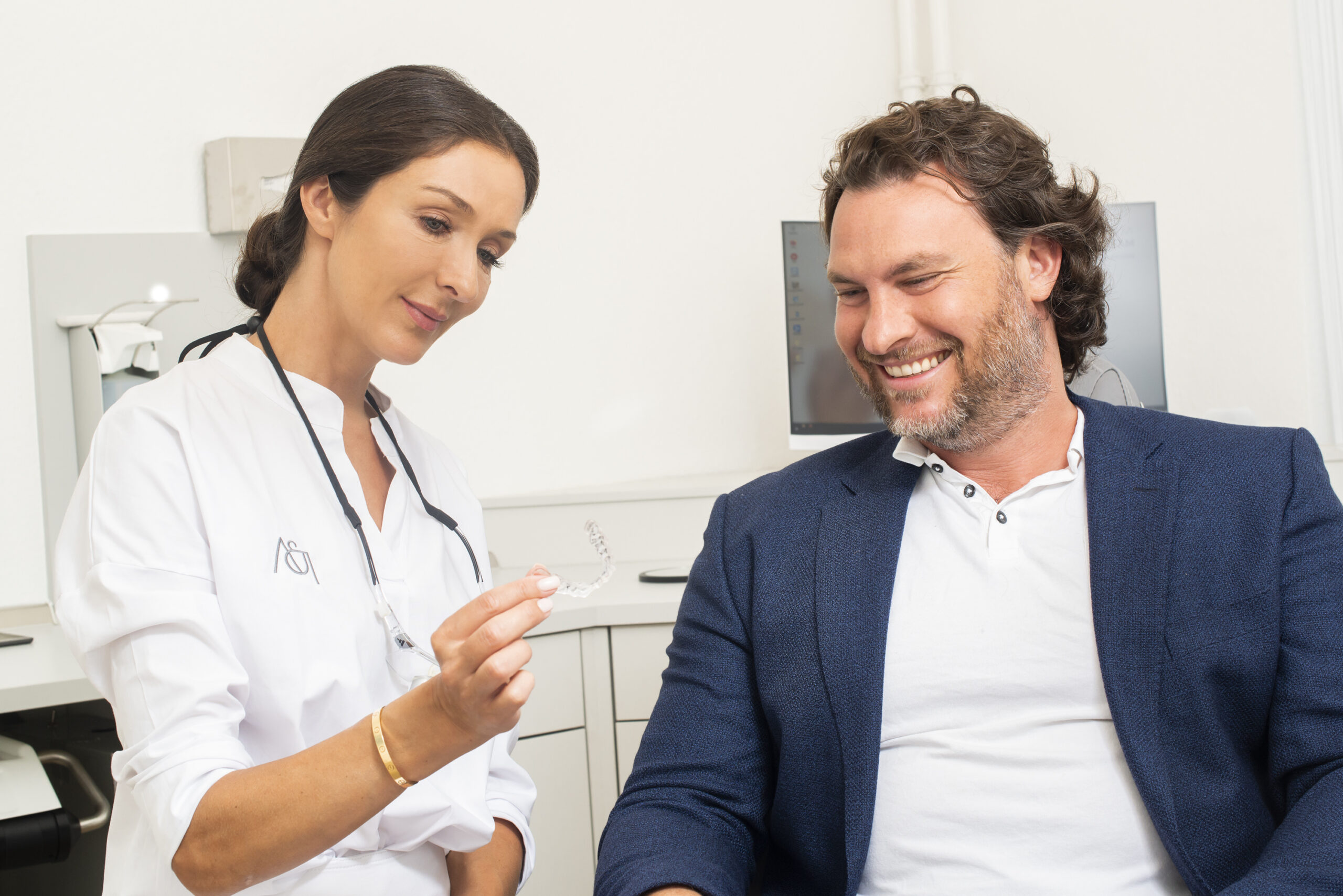
An aligner for adults—it sounds easier than it sometimes is. Anyone looking into this has usually already read quite a bit: testimonials, price comparisons, before-and-after photos. And yet, most questions don’t come up until the treatment becomes a concrete reality. I, Dr. Alessja Indin, work every day at my practice on Ludwigstraße in Offenbach with people who want to undergo orthodontic treatment—and who…
-

How long do veneers last? This is one of the most common questions asked by patients considering this treatment. The honest answer: between five and fifteen years—sometimes even longer. But why such a wide range? Veneers are wafer-thin ceramic shells that are bonded to the front surface of the front teeth. They change the color, shape, and position of a tooth without…
-
In my practice, dental implants are the topic that patients most often bring up with a half-finished sentence: “I’d like to get an implant, but…” But I smoke. But I don’t have enough bone. But I’m too old for that. But I’m afraid. But I’ve heard they don’t last. I hear these five objections regularly during consultations at my office on Ludwigstraße in Offenbach.…
-
Dentosophy didn't come to me through a textbook. It came to me through my own daughter. Being both a mother and a dentist isn't always an advantage. You know too much to feel at ease—and too little to have an answer right away. I sat with her at the orthodontist's office, listened to the options, and had the feeling that…
-

Root canal treatment is a source of anxiety for many people. There are reasons for this, but they often disappear when you take a closer look. Anyone in Offenbach facing root canal treatment usually has the same questions: Will it hurt? How long will it take? How much will it cost? And above all: Who can I trust with my tooth? This article summarizes the seven most important points…
